
 English
 Türkçe
 Français
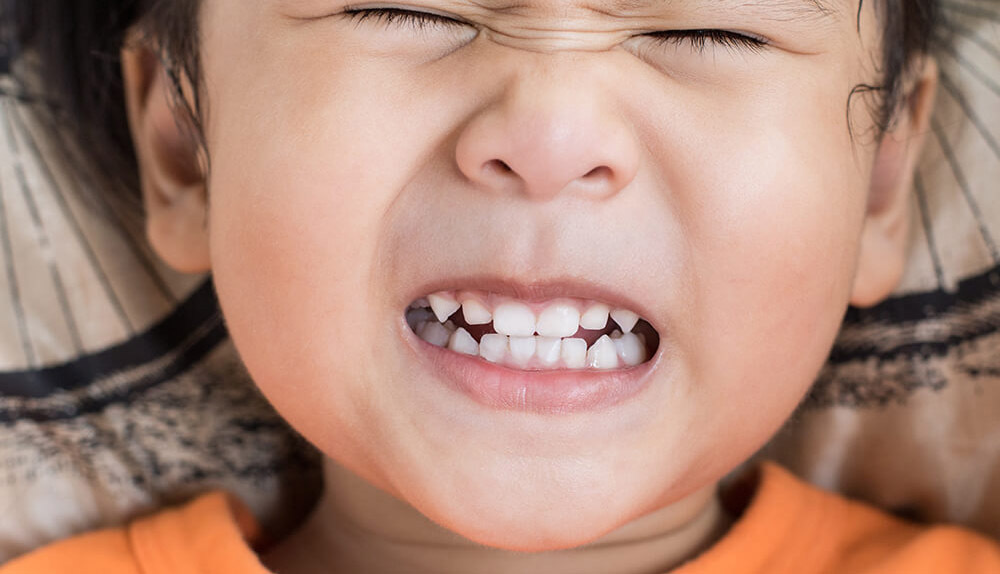
What Causes Teeth Grinding in Children?
Teeth grinding in children may appear as involuntary clenching of the teeth or rubbing them against each other.
Teeth grinding, especially during night sleep, is usually noticed by the parents rather than the child.
In some children, this condition may occur periodically and decrease on its own without causing any permanent problems.
However, severe teeth grinding that continues for a long time can put pressure on the teeth and jaw joints, so it should always be evaluated by a pediatric dentist.
What Are the Causes of Teeth Grinding in Children?
The causes of teeth grinding in children may vary with age.
Especially in young children, differences in jaw movements may be observed during tooth eruption and changes in the mouth.
The process of adapting to the new bite pattern formed by the eruption of baby teeth and later permanent teeth may be accompanied by teeth grinding in some children.
Stress and anxiety are also among the factors that may be associated with teeth grinding.
Changing schools, exams, problems in the social environment, changes within the family or other situations affecting the child in daily life may manifest as night-time clenching and teeth grinding in some children.
However, it is not correct to assume that teeth grinding stems only from psychological causes.
Certain conditions related to the structure of the mouth and teeth should also be evaluated.
Clenching and grinding may occur in some children due to differences in the bite, crowding, a large number of cavities, filled or missing teeth in the mouth, and problems related to jaw development.
Nevertheless, the relationship between teeth grinding and bite disorders is not the same in every child.
Does Teeth Grinding Damage Children's Teeth?
Short-term and mild teeth grinding does not always cause significant damage to the teeth.
However, long-lasting or severe clenching and grinding can lead to wear on the tooth surfaces.
Especially with the eruption of permanent teeth, follow-up may be needed for sensitivity, surface loss or cracks in the teeth.
If there are symptoms such as jaw pain in the morning, headache, discomfort while chewing or clicking sounds from the jaw joint, a dental evaluation is important.
In addition, check-ups should not be delayed when noticeable wear, fractures or sensitivity are observed in the teeth.
When teeth grinding is noticed in children, it may not be the right approach for parents to constantly warn the child not to clench their teeth during the night.
First of all, how often it occurs, its relationship with sleep and whether there are any accompanying symptoms should be evaluated.
How Is Teeth Grinding Treated in Children?
The treatment of teeth grinding does not depend on a single method.
First, an attempt is made to determine the possible cause.
During the examination by the dentist, wear, fractures and sensitivity in the teeth, jaw movements and the bite are evaluated.
It should not be assumed that a night guard needs to be used in every case of teeth grinding in children.
Especially in children whose growth and tooth and jaw development are still ongoing, whether any appliance should be used and its suitability should be determined by a pediatric dentist.
Establishing a sleep routine, creating a calm bedtime routine to help the child relax and evaluating sources of daily stress may be beneficial for some children.
If there are symptoms related to snoring or mouth breathing during sleep, an evaluation by a pediatric dentist, a pediatrician and an ear, nose and throat specialist may be necessary.
Frequently Asked Questions
1. Is teeth grinding normal in children?
Teeth grinding may be seen periodically in some children and may decrease over time.
However, frequently recurring clenching and grinding, or grinding that causes wear on the teeth, should always be evaluated by a pediatric dentist.
2. Is teeth grinding in children caused by psychological reasons?
Stress and anxiety may be associated with teeth grinding, but they are not the only causes.
Tooth development, mouth and jaw structure, sleep patterns and certain sleep problems should also be evaluated.
In addition, some systemic and chronic conditions may also be associated with teeth grinding.
3. Is a night guard used for teeth grinding in children?
In some cases, the use of a night guard or appliance may be planned.
However, since tooth and jaw development is still ongoing in children, whether such an application is necessary and suitable should be decided by a pediatric dentist.
The cause of teeth grinding in children and its effects on the teeth may vary from person to person.
Dental Estetik Center comprehensively evaluates children's oral and dental health and helps create the follow-up and treatment plan needed for problems such as teeth grinding.


 by
